




China is an emerging giant at the global scale. A country that was wrestling with poverty forty years ago has now become a country of great success and abundance. Its success in alleviating poverty serves as an inspiration for others that are still fighting poverty. As China is rising economically, its scope of global engagement is also expanding. Developing countries are keen to maintain strong relations with China among others.
China seems ready to work with every state of the world but with one precondition, i.e. recognizing its one-China principle. This is a principle that indicates the unity of Taiwan with Chinese mainland. China considers the island as an integral part of its own territory for reasons that are both historical and legal. China expects all states of the world to recognize the territorial integrity. This is a firm stand of the People’s Republic of China (PRC) since it was established in 1949.
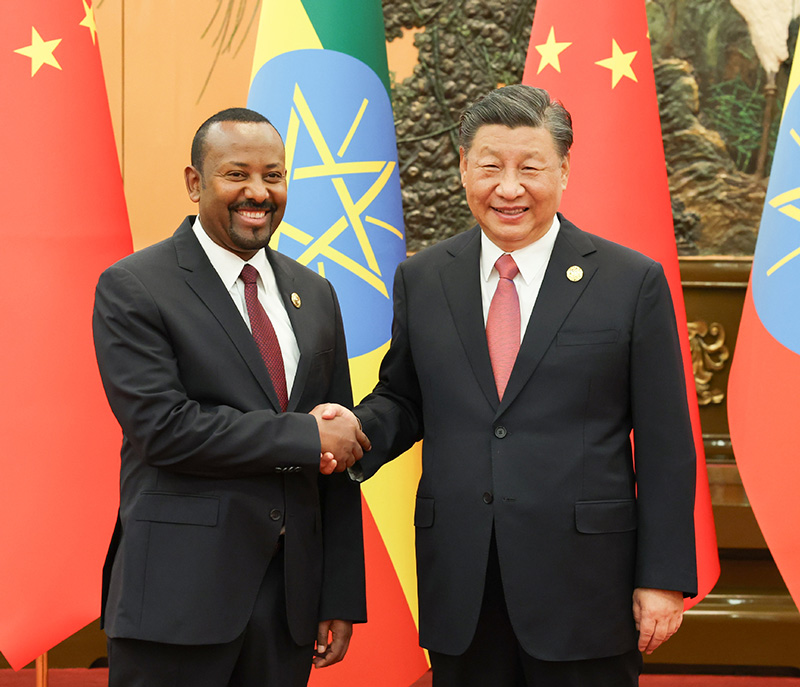
Nevertheless, due to the dominance of ideological rivalry during cold war and the geopolitical rivalry in the 21st century, different states reflect different positions towards one-China principle. Ethiopia is one of those states that consistently support the unity of China under Beijing especially after 1971. The bilateral relations between Ethiopia and China entered a new phase of positive development following the end of cold war. For about a decade after 1991, the two states have laid the foundation for the later years of strong economic and political relations. China and Ethiopia enjoyed even closer political and economic relations following the new millennium. As Ethiopia began a development journey, the role of China as a cordial cooperation partner becomes insurmountable.
The strong bilateral relations have been anchored in the respect of the one-China principle. For anyone who closely follows up the foreign policy approach of Ethiopia, the commitment to the one-China principle means many things. The objective of this brief article is tied to the explanation of three important justifications that explains Ethiopia’s position towards China.



A commitment to the Post-War arrangement and the UN system
Before the beginning of WWII, Ethiopia had joined the League of Nations with the assumption that the world would be a safe and stable place for humanity through collective security arrangements. At the time, almost all African nations were colonized, difficult to establish some form of African partnership or unity towards better security and development. The only alternative was joining the League. Ethiopia tried its best to protect itself from the possible aggression and also to reflect its voice in front of other states. However, the League failed to rescue Ethiopia from Italian invasion a year before the beginning of the WWII. No one was to the side of Ethiopia though the League was based upon the principle to respect the sovereignty and security collectively.
As Italy has occupied Ethiopia for five years, 1939-1944, Japan invaded China. However, both Italy and Japan were losing ground especially after 1943. Leaders of China, the US and the UK met at Cairo and deliberated the way the Japanese invasion could be eliminated and the return of historical Chinese territories to China. As to the Cairo Declaration, 1943, it says:
It is their purpose that Japan, shall be stripped of all the islands in the Pacific which she has seized or occupied since the beginning of first World War in 1914, and that all the territories Japan has stolen from the Chinese … shall be restored to the Republic of China.
This decision had served as a roadmap in the post-War Asia Pacific arrangement by great powers. It brought about an ample opportunity for the post-War China. In the same manner, the leaders of the three nations met in September 1945 and discussed the mechanisms of surrendering Japan. The Potsdam Declaration was the outcome of the meeting which called upon Japan either to surrender or to face with a final blow by the combined forces of China, the US and the UK. It further consolidated the fact that ‘the Cairo Declaration shall be carried out’ (Article 8). The war did not last long and Japan was vanquished by the combined forces. Hence, China should secure all of its lost territories and also got the opportunity to be the permanent member of the Security Council in the newly established United Nations (UN) organization.
Ethiopia also joined the UN at its establishment and became an active member after then. Their relation with China was also based on the principles and decisions of the organization. Ethiopia has been consistently accepted the one-China principle especially after the two nations established diplomatic relations in 1970 and followed the UN General Assembly (UNGA) Resolution 2758 in 1971, which decided the following:
Recognizing that the representatives of the Government of the People’s Republic of China are the only lawful representatives of China to the United Nations and the People’s Republic of China is one of the five permanent members of the Security Council.
Decides to restore all its rights to the People’s Republic of China and to recognize the representatives of its Government as the only legitimate representative China to the United Nations …
By fulfilling the Resolution, Ethiopia showed its allegiance to the purposes and principles of the UN Charter. Gearing the Ethio-China relations on the basis of the one-China principle also helped to make the bilateral diplomacy strong.
It is after all an internal affair of China
The war of liberation from Japan was concluded with the defeat of Japan by allied forces in 1945. The Koumintang Party (KMT)-led Government was in power when China liberated its territory from Japan. With the end of WWII, the capability of KMT was declining vis-à-vis the revolutionary army of Communist Party of China (CPC). In 1949, the CPC revolutionaries entered into Beijing and declared the establishment of the PRC. The KMT, then, fled to China’s island of Taiwan.
The Taiwan authorities then still retained the international recognition which helped it to keep its position in the United Nations Security Council (UNSC) and kept bilateral relations with countries that did not recognize the PRC as a legitimate government. The PRC, on the other hand, was in a diplomatic move to get the recognition which was then accorded to the Taiwan authorities. After many years of diplomatic efforts, the UNGA Resolution 2758 decided the restoration of the lawful rights of the PRC, stating that the PRC Government is the sole legal government of the whole China and that Taiwan is an inalienable part of China.
Following the decision, PRC restored its lawful seats in the UNSC and became the legitimate representative of China in the UN and all its agencies. The Government in Beijing also embarked political and diplomatic initiatives of Taiwan’s return to its motherland. The one-China principle has therefore emerged as the guiding principle for the Chinese Government in its dealing with all nations across the world. Continuous political negotiations were also made between Beijing and Taipei to achieve the unity of China.
There has been numerous political negotiations at different levels, sometimes by high profile politicians and sometimes by experts, since 1971 between the two. One could mention days of political stalemate with the absence of middle ground amongst them and there were also times where negotiation was possible to the extent of reaching some agreed upon roadmap. The whole dynamics related with Taiwan proved that Taiwan Question is entirely a domestic challenge of China. Thus, Ethiopia has no any reason to comment on the domestic affairs of China let alone taking contrary position to the one-China principle. That is why Ethiopia has maintained strong bilateral relations so far with China. Refraining from intervening in the internal affairs of another country is a constitutional provision to Ethiopia. All governments coming into power constitutionally have the duty not to defy this provision. Even in the future, Ethiopia will respect China’s way of dealing its internal matters.
Whenever any nation makes itself for healthy bilateral relations, the first thing that it does is to identify the interests and the sensitivities of its counterpart and take all necessary caution. It is also wise to discern
interests that are common from those that are exclusive to the other. States do not allow exclusive interests to spoil the common interests. The bilateral relations between Ethiopia and China have to also be seen from this perspective. The sustainability of the bilateral relations is dependent more on working mutually on the common interests.
The development cooperation is rising
As a country with fast-growing economy, it is natural for Ethiopia to give priority for development cooperation. Such cooperation goes far beyond besides aid and support. It is also a matter of soliciting finance that is necessary for development either in the form of investment or loan. In this case, the Ethio-China relations have gone further. China is an important source of Foreign Direct Investment (FDI) to Ethiopia which is critical to reduce the unemployment burden, to facilitate urban development and fill the foreign exchange gap. Chinese companies are also increasingly participating in the infrastructure sector in Ethiopia, involving themselves in the construction of roads and railway lines, skyscrapers, telecom infrastructure and hydroelectric dam projects, to mention just a few. The trade relations between the two nations are also rising on both sides.
It is possible to expect this type of development cooperation to keep the momentum in the future. The rapid economic growth and the huge market in Ethiopia may attract more and more investors and trading partners from China. This type of strong development cooperation actually began to happen following the commencement of Forum on China-Africa Cooperation (FOCAC) in 2000. Following the promises of FOCAC, China pursued strong partnership with African states that accepted the one-China principle. Ethiopia, as part of FOCAC, has worked with China for stronger relations that could benefit both nations and it is also possible to expect a better partnership in the foreseeable future.
For China, the one-China principle is a cardinal norm in its foreign policy and any type of engagement. Other than this, it is open to have every possible bilateral or multilateral relations with states from across the world. Ethiopia is well-cognizant of China’s sensitivity to its internal affairs and wants to respect its position and the way it manages its own affair. The future of the bilateral relations will be more successful as long as both nations work in areas that are common.
Editor’s Note: The views entertained in this article do not necessarily reflectthe stance of The Ethiopian Herald
BY DARESKEDAR TAYE, (PhD) THE ETHIOPIAN HERALD SATURDAY 18 MAY 2024